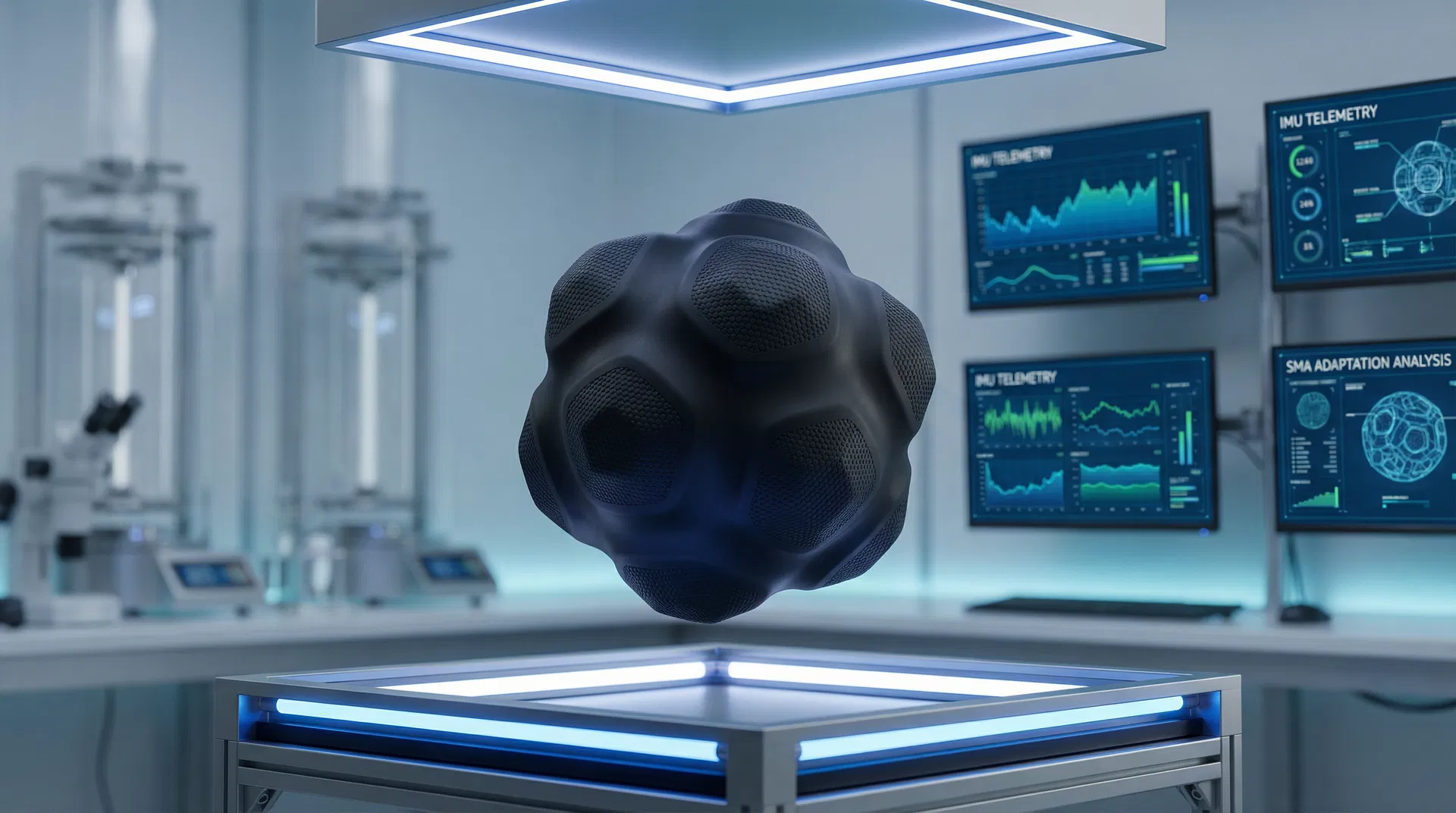
THE SMA ADAPTOR
The SMA Adaptor (Sensorimotor Adaptation Adaptor) is a high-fidelity, bio-kinetic research tool disguised as an unpredictable reaction sphere. It is a dynamic probe for the human nervous system—a physical interface for measuring and mitigating the degradation of the nervous system's comparator, the internal mechanism that matches sensory feedback against intended motor commands.
By integrating a state-of-the-art 6-axis Inertial Measurement Unit (IMU) sampling at 1000Hz within a mathematically irregular rubber geometry, the SMA Adaptor provides a high-resolution window into the black box of human motor control and attentional reserve.
DESIGN & PHYSICALITY
The SMA Adaptor is crafted from a proprietary, high-density vulcanized rubber with a specific durometer rating optimized for high-velocity displacement. Its multi-faceted, "lobate" geometry is specifically designed to maximize signal noise—forcing the nervous system to work harder to extract meaningful information from chaos.
Tactile Mapping
The surface features a micro-textured "grip-lattice" that provides high-frequency tactile input to the mechanoreceptors in the palms and fingertips—essential for users with diminishing peripheral sensitivity.
Irregular Geodesics
The lobes are weighted non-uniformly, creating a "weighted-eccentric" flight path. This forces the brain to constantly update its predictive model of the ball's trajectory in real-time—a direct measure of the nervous system's ability to adapt under uncertainty.
TECHNICAL CORE: 6-AXIS BIO-TELEMETRY
Inside the core sits a shock-isolated 6-axis IMU, sampling at 1000Hz. This allows the device to capture data points far beyond the binary of "catch or drop."
Tri-Axial Accelerometry
Measures the intensity of impact and the G-load of the catch. This data identifies the Dampening Constant—how efficiently a user's muscles and joints absorb kinetic energy. A critical marker of neuromuscular aging.
Tri-Axial Gyroscopy
Tracks the rotational velocity (angular rate) of the ball. In the context of motor control, this measures the user's ability to track and stabilize spin and torque—often the first sensory inputs to degrade with age.
THE ADAPTATION FRAMEWORK
The "Adaptor" in its name refers to its primary function: forcing the nervous system to undergo rapid sensorimotor re-mapping. The device measures not just what you can do, but how your nervous system reorganizes when constraints are introduced.
Dual-Task Interference Protocol
Via its connected app, the device introduces cognitive constraints (auditory Stroop tests, spatial reasoning prompts) simultaneously with the physical task. By comparing 6-axis data during "pure" play versus "saturated" play, researchers can quantify the Attentional Cost of movement—a direct measure of cognitive reserve.
Jerk Profile & Motor Smoothness
In aging populations, motor output often becomes "staccato" or jerky. The SMA Adaptor tracks the smoothness of the hand's approach to the ball. Low-jerk catches indicate high-functioning predictive control. High-jerk catches indicate reliance on slower, reactive visual feedback—a marker of nervous system degradation.
FUNCTIONAL PERFORMANCE INDICATORS
The SMA Adaptor app translates raw IMU telemetry into a suite of metrics that quantify nervous system function:
The Proprioceptive Index
A score reflecting how accurately the user "met" the ball in space without visual over-reliance. Measures the integrity of proprioceptive signaling.
Correction Latency
The time in milliseconds between a "mis-catch" (detected via gyroscope wobble) and the user's corrective grip adjustment. A direct measure of reactive control speed.
Stochastic Resonance Score
Measures the user's ability to find "rhythm in the noise" over a set of 50 bounces. Quantifies the nervous system's capacity to extract signal from chaos—a marker of attentional reserve.
APPLICATIONS IN PERFORMANCE RESEARCH
The SMA Adaptor is positioned as more than a training tool. It is an adversarial research apparatus—a closed-loop feedback environment where the adversary is physics itself.
Constraint Saturation Training
By manipulating the environment (lighting, floor texture, auditory load), users can "saturate" their constraints. The SMA Adaptor measures the exact point where motor control collapses—and where it can be rebuilt.
Longitudinal Neuro-Tracking
For aging users, the SMA Adaptor serves as an early-warning system. A downward trend in "Stabilization Velocity" (how fast the ball is brought to zero rotation after a catch) can signal neurological changes long before they manifest in daily activities like walking or driving.